Table of contents
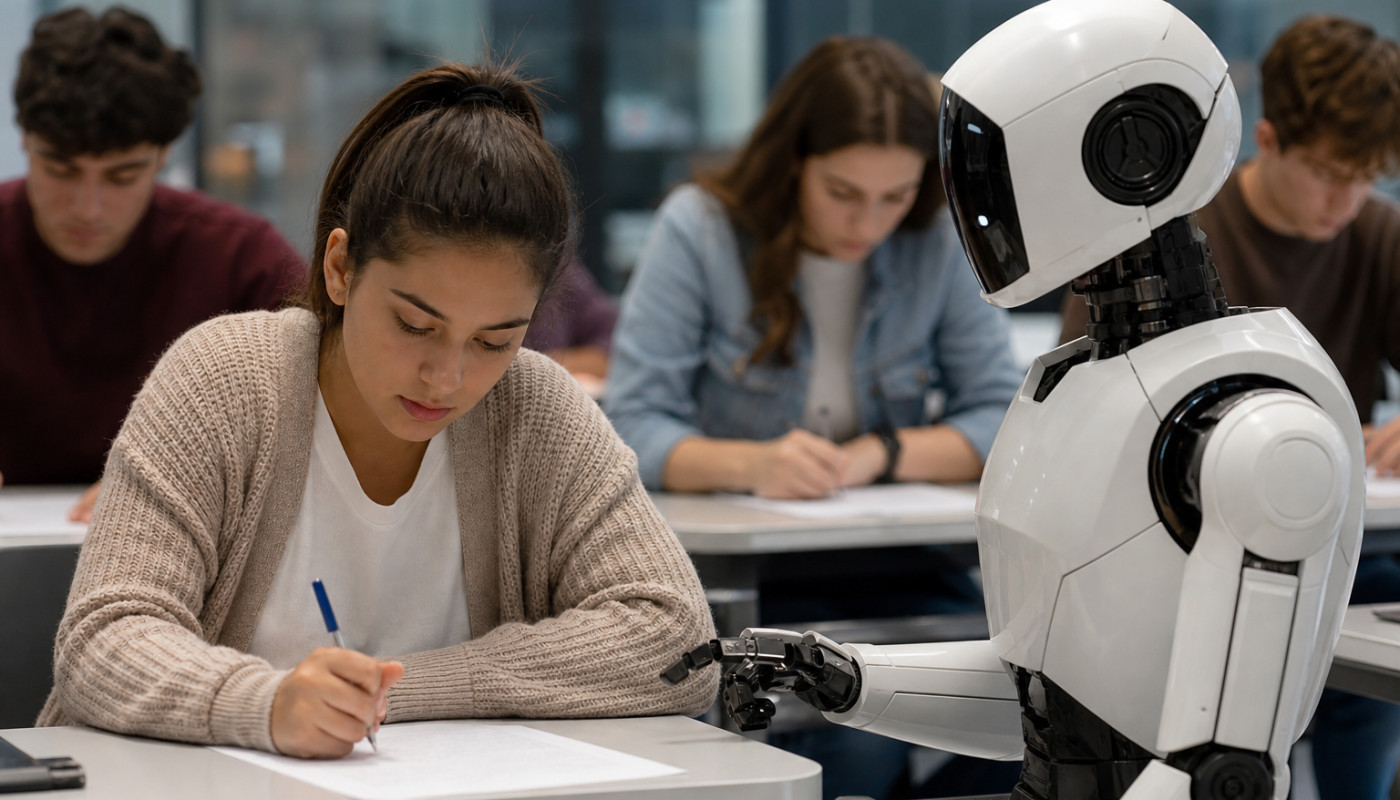
Cheating has always evolved with technology, but generative AI has accelerated the arms race, from auto-written essays to real-time “whisper” answers during remote tests. Schools and universities are reacting fast, tightening proctoring rules, redesigning assessments, and investing in detection tools, yet the evidence is mixed and the stakes are high. The question now is not whether AI will enter exams, it already has, but whether AI can credibly protect academic integrity without breaking trust, privacy, and fairness along the way.
Cheating goes real-time, and harder to spot
Ask any lecturer what changed since 2022 and you will hear the same answer: the volume, the speed, and the plausibility. Large language models can draft essays that read “good enough” in minutes, translate and paraphrase across languages to mask copying, and generate citations that look legitimate at first glance, even when sources are weak or fabricated. In the United States, the 2023-2024 academic year saw a surge in reported AI-related misconduct cases across multiple campuses, and while institutions vary in how they classify incidents, many academic integrity offices describe a clear shift from traditional plagiarism toward “unauthorised assistance” that is harder to evidence.
Remote and hybrid assessment has also widened the attack surface. Students can now run an AI assistant on a second device, prompt it with a screenshot, and receive step-by-step reasoning in seconds, including for quantitative subjects. That is a different kind of cheating: not copying answers after the fact, but outsourcing cognition in the moment. It is also why older approaches, such as matching text against online sources, feel blunt. When the output is original but not authored by the student, the classical definition of plagiarism starts to wobble, and the burden of proof becomes a minefield for educators.
There is data behind the anxiety, even if measurement remains messy. A 2023 survey by the UK’s Higher Education Policy Institute found that a significant share of students had used generative AI for assessments, with usage rising sharply within months of ChatGPT’s release. Similar patterns appeared in U.S. polling of college students, where many reported using AI tools for brainstorming and editing, and a smaller but material subset admitted using them to produce full answers. The signal is consistent: adoption is widespread, intentions vary, and enforcement lags behind behaviour.
Yet the most difficult problem is not the student who submits an obviously machine-written essay, it is the student who blends AI output with their own voice, or uses AI as a “silent tutor” during online tests. The more AI becomes conversational and multimodal, able to interpret images and solve problems step by step, the more cheating moves from detectable artefacts to invisible process. If the exam environment cannot control inputs and outputs, the line between learning support and dishonest assistance becomes both cultural and technical, and that is where the next phase of the exam debate is heading.
Detection tools promise certainty, but deliver disputes
Can AI catch AI? Vendors say yes, universities want to believe them, and students fear being falsely accused. The reality is more fragile. Major AI-writing detectors have repeatedly been criticised for false positives, particularly for non-native English writers and for students who use simpler sentence structures. Even OpenAI discontinued its own AI Text Classifier in 2023, citing low accuracy. That decision landed like a warning flare: if the company behind one of the most influential models cannot reliably detect machine-written text, institutions should be cautious about turning detectors into disciplinary evidence.
Independent evaluations have found performance can degrade quickly when students paraphrase, mix outputs, or prompt models to adopt a personal style. Detection can also be gamed by re-typing, altering punctuation, or passing text through rewriting tools. In practice, many universities that experimented with automated flags have shifted toward a more conservative posture: using detectors as one signal among many, not as a verdict. That means looking for process evidence, such as drafts, version histories, and oral explanations, and comparing the submitted work with a student’s prior writing. It is slower, and it demands staff time, but it is closer to due process.
The risk is not just technical, it is legal and reputational. A false accusation can escalate into formal complaints, appeals, and even litigation, and it can damage trust between students and faculty. At the same time, ignoring the problem erodes the value of credentials. That tension has pushed some institutions to redesign assessments rather than chase perfect detection, because detection alone tends to produce a whack-a-mole dynamic: each new tool triggers a new workaround, and the classroom becomes a surveillance contest instead of a learning environment.
Still, AI does have a role on the enforcement side, particularly in pattern analysis. Unusual answer similarities across large cohorts, improbable time-to-completion patterns, and abrupt changes in writing complexity can help identify where human review should focus. The most credible approach is layered: limited detection, careful human judgment, and transparent policies that explain what counts as acceptable use. For educators looking to understand how AI systems work and how they are evolving, resources that track tools and capabilities closely, such as this website, can help keep decision-makers grounded in what is technically realistic, and what is marketing hype.
Exams are being redesigned, not just policed
Surveillance is one route, but redesign is the quieter revolution. If AI can draft a generic essay, then generic essays become less useful as proof of learning. That is why many schools are moving toward assessments that require context, reflection, and personal connection, elements that are harder to outsource convincingly. Oral exams are returning in some departments, sometimes in short “viva” formats that test understanding rather than memorisation. In-class writing is also making a comeback, not out of nostalgia, but because controlled environments still matter when unsupervised devices can provide instant help.
Another shift is toward process-based grading. Instead of marking only the final submission, educators ask for outlines, annotated bibliographies, intermediate drafts, and short reflections explaining choices. This does not eliminate AI use, it reframes it. Students may be allowed, even encouraged, to use AI for brainstorming or language polishing, but they must document prompts, outputs, and how they changed the material. That approach mirrors real workplaces, where AI assistance is becoming routine, and it reduces the incentive to hide usage. It also gives instructors a clearer view of authorship, because the learning is visible in the steps, not just the product.
There is also experimentation with “AI-inclusive” assignments, where students must critique AI-generated responses, compare them with scholarly sources, and correct errors. This exploits a known weakness: AI can be fluent but wrong, and catching those mistakes is a sign of understanding. In quantitative fields, some instructors are using more open-book, open-resource exams that emphasise reasoning, explanation, and novel application, because banning tools completely can be unrealistic. Instead, they test what AI cannot reliably provide: domain-specific judgment, the ability to justify assumptions, and the skill of checking results.
None of these solutions is frictionless. Oral exams require staffing and scheduling, process grading increases workload, and in-class assessments can disadvantage students with anxiety or accessibility needs unless accommodations are carefully built in. Yet the direction of travel is clear. The future of exams is less about catching cheaters after the fact, and more about designing tasks where cheating offers diminishing returns, because the assessment asks for authentic thinking, traceable work, and accountable explanation.
Fairness, privacy, and trust will decide what lasts
Even if AI could perfectly detect cheating, should it be deployed everywhere? That question is already reshaping policy. Remote proctoring tools, which may record video, audio, keystrokes, and screen activity, expanded rapidly during the pandemic, but they also sparked backlash. Students and civil liberties groups have raised concerns about biometric surveillance, data retention, and the risk of biased flagging, for example when gaze tracking misreads neurodivergent behaviour, or when lighting and skin tones affect computer vision accuracy. In several cases, universities scaled back or reviewed proctoring contracts under student pressure.
Regulators are also moving. The European Union’s AI Act, adopted in 2024, introduces risk-based obligations for certain AI systems, and while education is not banned territory, institutions operating in Europe will face a more formal compliance culture around transparency, data governance, and accountability. In the United States, privacy rules vary by state, but the direction is similarly toward more scrutiny of sensitive data collection. That matters because exam security tools often sit at the intersection of education records and biometrics, a combination that can quickly become politically explosive.
Trust, meanwhile, is the currency that exams rely on. If students believe they are being watched by opaque systems, or that an algorithm can accuse them with limited recourse, the legitimacy of assessment suffers. If faculty believe most work is AI-assisted and untraceable, grading becomes cynical. The sustainable path sits between these fears: clear rules, proportional security, and an honest acknowledgment that AI is not going away. In that model, institutions define acceptable use, teach AI literacy, and reserve heavy-handed monitoring for high-stakes settings where it is genuinely justified.
AI may well help secure certain exam formats, particularly by identifying anomalies and supporting human review, but it will not “outsmart” cheating in any final sense, because cheating is not a single trick, it is adaptive behaviour. What can win is a system that combines smarter assessment design with enforceable integrity standards, and that treats students as partners in credibility rather than targets of suspicion. The future of exams will be decided as much by legitimacy as by technology.
What students and schools can do now
Plan assessment changes early, and budget for them: oral components, more invigilation, and process-based marking cost time, not just software fees. Reserve proctoring for truly high-stakes tests, and negotiate contracts that limit data retention and clarify appeals. Where AI use is permitted, require disclosure, drafts, and prompt logs, and train staff to evaluate reasoning, not just phrasing.
Similar articles

How AI Assistants Are Shaping The Future Of Remote Work

How To Choose The Right CNC Machining Center For Your Needs?
How Choosing The Right Chatbot Builder Enhances Customer Engagement

Exploring The Impact Of Advanced Signal Boosting On Business Productivity

Exploring The Benefits Of Streamlined Cluster Management Tools

Exploring The Benefits And Setup Of Omnichannel Chatbot Platforms

How To Effectively Manage A Ransomware Crisis In Your Company

Exploring The Role Of Intuition In Enhancing Patient Care Efficiency

Exploring Career Paths In Consulting In The Era Of Digital Communication Tools
